Copy Stand / Repro Stand / Repro Column
2018 / 2022 © Thomas Gade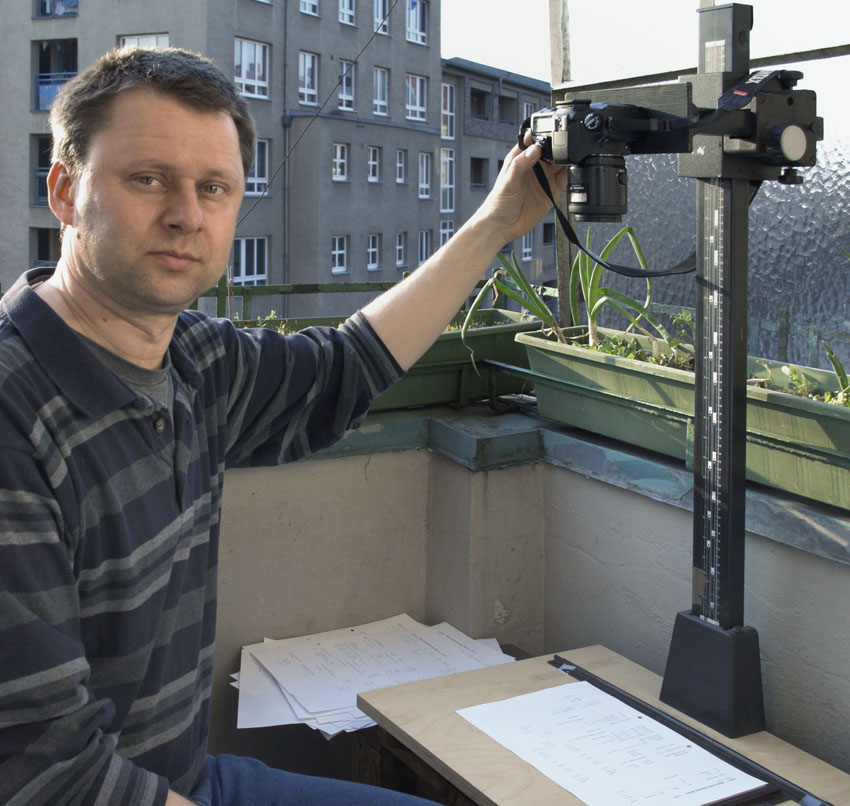
Thomas Gade using a Dunco copy stand to photograph documents
Purpose
A copy stand is designed for photographing flat originals, like documents, drawings, or prints, from directly above. The camera is aligned perfectly vertical, something regular tripods aren’t ideal for. A copy stand typically consists of three main components:
Baseboard
This is usually a thick, rectangular wooden board that serves as a stable base and provides the surface for placing originals. Some baseboards are made of metal, allowing magnets to be used for securing accessories. Less commonly, U-shaped bases are used instead of a solid board.
Vertical Column
A sturdy vertical column is mounted at the back edge of the baseboard, usually made from an aluminum extrusion.
Height-adjustable Camera Arm
Attached to the column is an arm that holds the camera. It can be moved up or down to adjust the distance between the camera and the subject, allowing precise control over framing and magnification.
Terminology
The German terms *Reprostativ*, *Reprosäule*, or *Reprostand* all refer to the same concept. In English, the common terms are *copy stand* or *repro stand*. Among German speakers, *Reprostativ* is the most widely used term today.
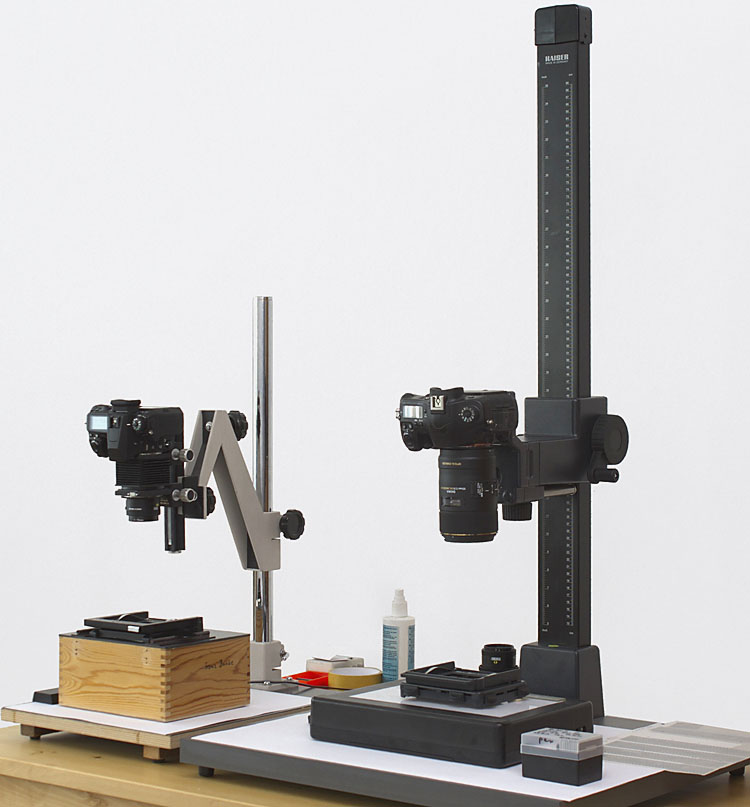
Different sizes. The black repro column is made by Kaiser.
Both copy stands shown here work extremely well for digitizing negatives and slides. The unit on the left uses a homemade baseboard, while the Kaiser stand on the right is mounted on its original baseboard.
If the stand is used exclusively for film digitization, the smaller size of the left setup is an advantage. It takes up less storage space and leaves more room on a desk.
Historical Background of Standard Sizes
The dimensions of many copy stands are rooted in traditional darkroom equipment. In the past, the baseboards and columns of enlargers were often repurposed. After removing the enlarger head (including the lamp, lens, and film carrier) an adapter with a tripod screw could be attached, turning the enlarger into a copy stand. Manufacturers like Dunco and Kaiser Fototechnik took advantage of this and produced both enlargers and copy stands using largely identical components.As a result, the size and load capacity of many copy stands still follow the requirements of classic enlargers. High-quality enlargers were expected to handle prints up to at least 30 × 40 cm. The paper easel required a footprint of roughly 40 × 50 cm. Baseboards around 50 × 50 cm therefore became standard for 35 mm and medium-format equipment. Copy stands of this size allow photographing originals up to A3 using a 50 mm lens on a full-frame DSLR.
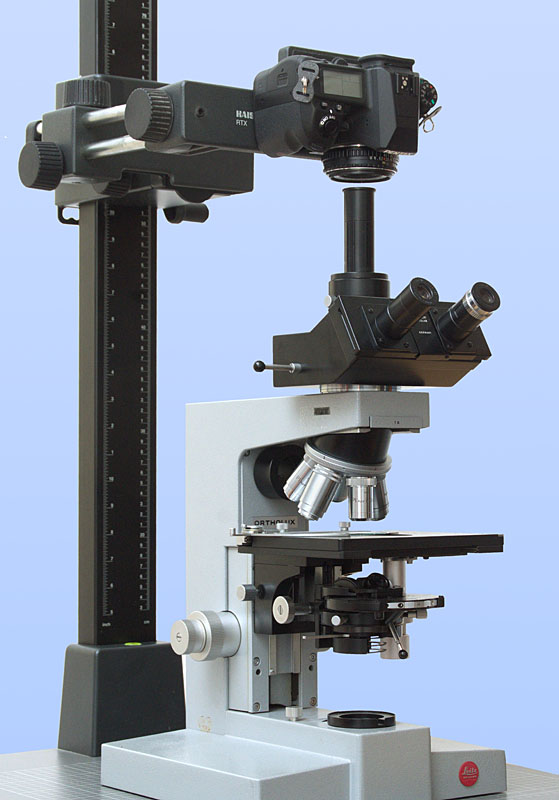
Microscope photography using a Kaiser repro column
I also use the larger Kaiser baseboard to support microscopes and position a camera precisely above the microscope’s photo port. The advantage is that a relatively heavy digital camera doesn’t put stress on the microscope’s head, and no wobbly adapters are needed.
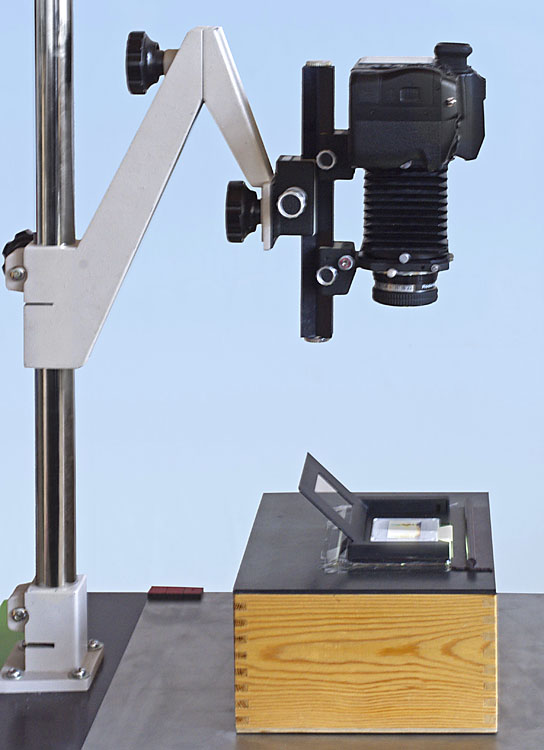
Small repro column with bellows unit for digitizing film
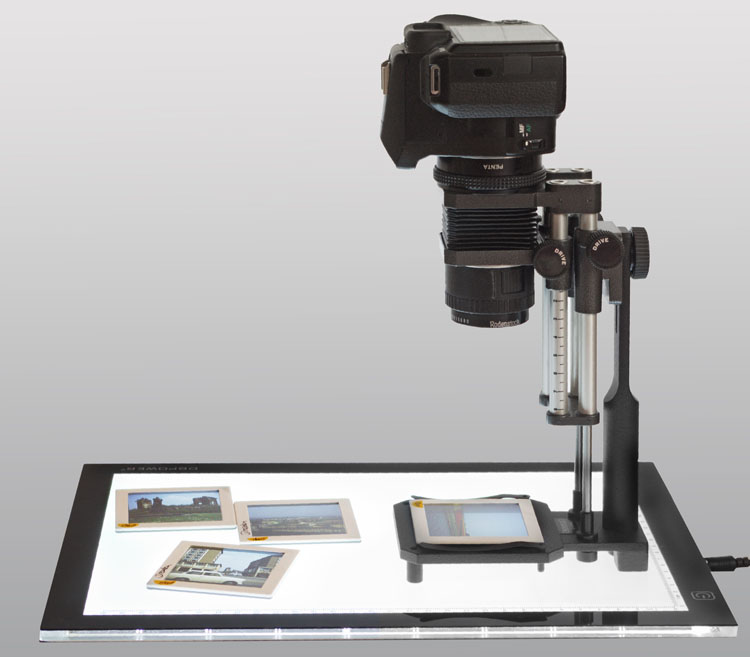
Novoflex Macro Stand with bellows unit for digitizing slides
This setup demonstrates how slides can be digitized with simple equipment. In actual use, a cover is placed on the light panel with only a small opening for the slide. This prevents stray light, reflections, and scratches caused by the small tripod resting directly on the light surface. Here, however, the distance between the slide and the light source is very small. Dust or scratches on the light panel may therefore show up in the image, even if they lie slightly outside the plane of focus.
It’s also noticeable that the camera is not positioned exactly over the center of the slide. As appealing as compact solutions may look, make sure the correct bellows unit is included when buying used Novoflex copy-stand sets so the camera can beligned properly.
Evaluation
Copy stands are extremely useful tools for a wide range of photographic tasks. New units can be fairly expensive, but since the basic design hasn’t changed much in decades, the used market is an excellent option. Starting around $100, you can find very capable equipment. I’m especially fond of the copy stands made by Kaiser. Dunco also produced solid models, which I used for many years, but I find the adjustment mechanisms on their camera arms less refined than those on Kaiser stands.There are many other good copy stands as well. If you need one strictly for digitizing slides and negatives or other small items, it may be worthwhile to shorten the column and replace a large baseboard with a smaller, sturdy one.